My face is having uncontrollable spasms. Great. It hurts really, really, really bad.
I think part of why I have trouble explaining pain to the doctor is when they ask about the pain scale I always think “Well, if someone threw me down a flight of stairs right now or punched me a few times, it would definitely hurt a lot more” so I end up saying a low number. I was reading an article that said that “10” is the most commonly reported number and that is baffling to me. When I woke up from surgery with an 8" incision in my body and I could hardly even speak, I was in the most horrific pain of my life but I said “6” because I thought “Well, if you hit me in the stomach, it would be worse.”
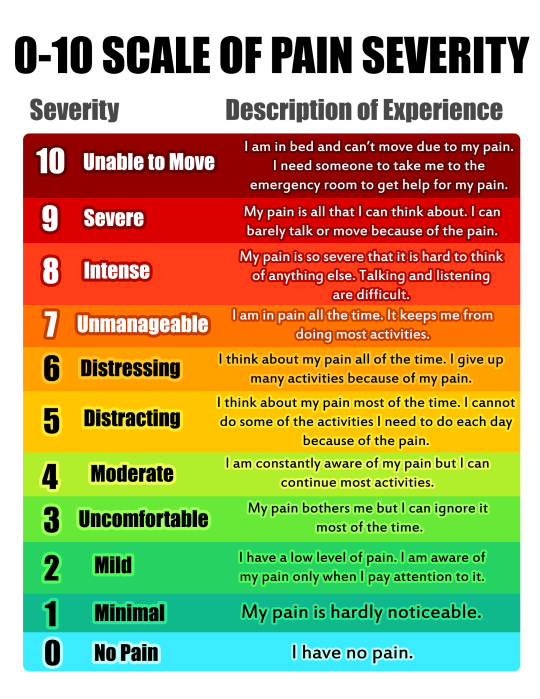
I searched and searched for the post this graphic was from, and the OP deactivated, but I kept the graphic, because my BFF does the same thing, uses her imagination to come up with the worst pain she can imagine and pegs her “10″ there, and so is like, well, I’m conscious, so this must be a 5, and then the doctors don’t take her seriously. (And she then does things like driving herself to the hospital while in the process of giving birth. Probably should have called an ambulance for that one!)
So I found this and sent it to her. Because this is what they want to know: how badly is this pain affecting you? Not on a scale of “nothing” to “how I’d imagine it’d feel if bears were eating my still-living guts while I was on fire”.
I hate reposting stuff, but I’ll never find that post again and OP is deactivated, so, here’s a repost. I can delete this later, i just wanted to get it to you and I can’t embed images in a chat or an ask.
This is possibly why it took several weeks to diagnose my fractured spine.
Pain Scale transcription:
10 – I am in bed and I can’t move due to my pain. I need someone to take me to the emergency room because of my pain.
9 – My pain is all that I can think about. I can barely move or talk because of my pain.
8 – My pain is so severe that it is difficult to think of anything else. Talking and listening are difficult.
7 – I am in pain all the time. It keeps me from doing most activities.
6 – I think about my pain all of the time. I give up many activities because of my pain.
5 – I think about my pain most of the time. I cannot do some of the activities I need to do each day because of the pain.
4 – I am constantly aware of my pain but can continue most activities.
3 – My pain bothers me but I can ignore it most of the time.
2 – I have a low level of pain. I am aware of my pain only when I pay attention to it.
1 – My pain is hardly noticeable.
0 – I have no pain.
It’s also really important to get this kind of scale to people who have chronic pain, because chronic pain drastically lowers your perception of how “bad” any kind of pain actually is, and yet something like this pain scale is extremely user friendly.
For example, if someone asked me how much pain I’m in at any given time, I’d say hardly any, and yet I’m apparently at a chronic 2.5, and it only goes up from there depending on the day.
if anyone would like to learn a couple tricks for carving pumpkins:
– dont cut out the top to scoop out the seeds, cut out the bottom instead. this way the pumpkin doesnt cave in on itself and lasts longer
– sprinkle some cinnamon inside at the top after carving. this way when you put the candle in it smells like pumpkin pie
this is the quality content I wanna see on my dash
– rub the i sides with lemon after you’re done scooping. This will also help preserve the pumpkin
It’s fucking June, at least wait until the fourth of July, you animal.
I’m sorry, I can’t hear you over the sound of me disemboweling this pumpkin.
Gather ‘round kids: I had a coworker mention to me this morning that it’s impossible to get grease stains out of fabric. As a former chemistry minor who worked two years under the table doing housekeeping and who generally tends to be a fucking disaster, I am here to tell everyone that it absolutely is not impossible, in case this is a widespread belief. Here are a few of my favorite cleaning stain removers that I always have at home.
Here are some options:
A Tide™ pen.
I’m a generic kinda lady. I hate promoting brands 99% of the time. BUT if you catch absolutely any kind of stain before it gets ground in, you can get most of it out with one of these babies. I’ve tested it on blood, chocolate, coffee, guacamole, pizza sauce, red wine on, on that one time i accidentally slopped some oil I was supposed to be using on antiques onto a fancy rug (also an antique but not the one I was gunning for). If you’re washing something delicate, pump it onto your finger a couple of times and gently rub it in. I’m not sure what they put in these things but I’m pretty sure it’s an arcane secret.
Dish soap
Granted, this is a little trickier for upholstery/carpet, but it can still be done using a rag, some water, and some patience. But for clothing, just pour some soap on the stain and rub it in under cold running water.
Absolutely any clear alcohol is your new best friend
You know the old “white wine to clean red” trick? Well, this is its updated sister I like to call “you, too, can use coconut rum to get red jello shot out of your nice white dress”. It’s a nice party trick. Straight vodka works even better. For every day situations involving any kind of alcohol-related spills (including markers)–and especially work situations–rubbing alcohol is ideal. To quote another adage, this one from every chemistry teacher you will ever meet, “like dissolves like.”
Hydrogen Peroxide
It can get blood out of absolutely anything, including your mattress. It reacts with the iron in hemoglobin, which breaks down the molecule, causing it to lose its red color. So make sure you’re not using a cast iron skillet to wash your period underwear in.
Vinegar
This will dissolve lime buildup overnight. Fill a bag, tie it around your showerhead, and presto. You can also use it to scrub the area around your sink and to break up any buildup in pipes. (Limeaway™ is for rich people.)
Baking soda
This is great if you have a pet or child who peed on the carpet. Just cover the area, wait until it dries, and vacuum it up. The longer you leave it, the better it will do at removing the smell. It’s also good removing mild odors from a small space, like a fridge or a laundry hamper.
Charcoal
This is your heavy duty odor killer. A little goes a long way. In chemistry, activated charcoal is used as a purifier in reactions, and in medicine, it can be used to treat mild poisoning/overdoses. In your car that smells like someone died because you forgot you had potatoes in the trunk for six months? All you need are regular old charcoal briquettes. Stick a couple handfuls in a flat box and the smell will be gone overnight. Guaranteed. For larger areas, just use more charcoal.
Baking soda is also good for stuff stuck on pots pans and your stove top. Add a little bit of water and elbow grease and it’s like magic
Baby shampoo will get oil stains out of clothing even if it’s been washed and dried several times. Shampoo is formulated to remove oil from organic stuff.
Thank you! There’s one thing about drawing portraits that I don’t think I’ve ever touched on, and it’s the technique of constraining features. Basically, it becomes easier and more intuitive to rotate the face in 3D space once your mind grasps exactly where the features are located and, furthermore, where they can’t be located.
I use a weird double trapezoid shape that I’ve depicted below in red to keep track of facial feature placement every single time I draw a face. It follows the top of the eyebrows, touches the corner of the eye, traces down to the corner of the lips, and finally ends at the bottom of the lips.
The shape of the constraint will change depending on the person’s features, and it works for every angle of the head. For me it really internalized where each part of the face was, as well as where it started and ended. It kinda helps moderate your drawings; i.e., you’ll stop drawing features that are wildly misplaced or off-sized. I don’t literally draw this shape out every time I draw a face, but I see it in my mind’s eye 100% of the time.
If you’re still learning proportions, a good exercise is to grab pictures of people and trace this shape over them (either digitally or with a marker or something) to get an idea of what realistic constraints looks like. Then go back to studying faces, and constantly check your drawing by tracing along the eyebrows and down to the bottom of the lips to make sure that things aren’t off (e.g., the constraint isn’t terribly asymmetric). It takes a while to get used to, but it might help you get a good feel for portraiture.
There’s one other unrelated thing I like to do with faces, and if you’ve seen a lot of my pics you’ve already picked up on it. If you kinda add some shading to the area on the cheek just below the eye and down to the nose, I think it adds a decent amount of depth to a face. Don’t go overboard of course but there’s another little tip that could be of use.


 love galore