Literally only got really into Spider Man like last month but I could NOT have picked a better time! Now I’m excited as both an animator and artist AND as a Spidey fan!
in general i think new york is very good for my social anxiety because no matter how much of a freak i’m being i know it’s probably not the weirdest thing people have seen today
case in point: i felt bad about bringing my unwieldy luggage onto a crowded train, until the man sitting next to me pulled a live fish out of his backpack
I introduced a friend to ATLA a few nights ago, and they had only
known two things about the entire show: the cabbage meme, and that Aang
apparently wants to ride every large and dangerous animal he can
possibly find. We got through the first five or so episodes, and my
friend noted that Aang is exactly what a 12-year-old would be like if
given godlike powers, and that this is literally just what he
could do with airbending. He can’t even wield any of the other elements,
and he’s one of the most powerful people on the planet, because he’s an
airbender.
And that got me thinking.
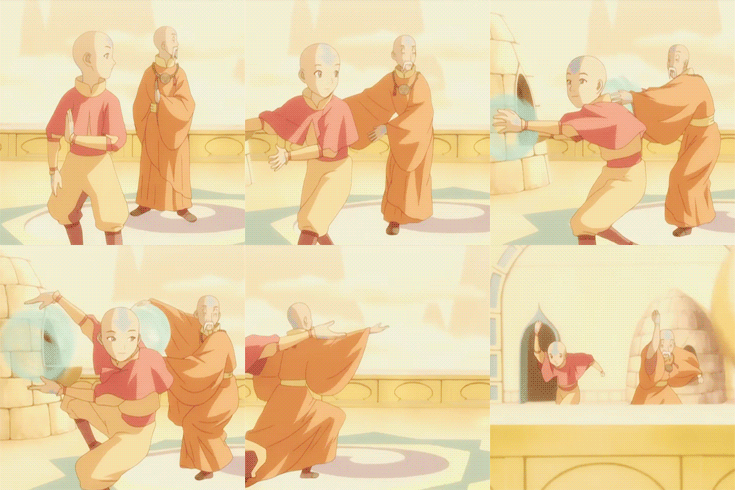
This snippet from Bitter Work is one of the few pieces of concrete information we get about the airbenders, at least in ATLA. Iroh is explaining to Zuko how all four of the elements connect to the world and to each other.
Fire is the element of power, of desire and will, of ambition and the ability to see it through. Power is crucial to the world; without it, there’s no drive, no momentum, no push. But fire can easily grow out of control and become dangerous; it can become unpredictable, unless it is nurtured and watched and structured.
Earth is the element of substance, persistence, and enduring. Earth is strong, consistent, and blunt. It can construct things with a sense of permanence; a house, a town, a walled city. But earth is also stubborn; it’s liable to get stuck, dig in, and stay put even when it’s best to move on.
Water is the element of change, of adaptation, of movement. Water is incredibly powerful both as a liquid and a solid; it will flow and redirect. But it also will change, even when you don’t want it to; ice will melt, liquid will evaporate. A life dedicated to change necessarily involves constant movement, never putting down roots, never letting yourself become too comfortable.
We see only a few flashbacks to Aang’s life in the temples, and we get a sense of who he was and what kind of upbringing he had.
This is a preteen with the power to fucking fly. He’s got no fear of falling, and a much reduced fear of death. There’s a reason why the sages avoid telling the new avatar their status until they turn sixteen; could you imagine a firebender, at twelve years old, learning that they were going to be the most powerful person in the whole world? Depending on that child, that could go so badly.
But the thing about Aang, and the thing about the Air Nomads, is that they were part of the world too. They contributed to the balance, and then they were all but wiped out by Sozin. What was lost, there? Was it freedom? Yes, but I think there’s something else too, and it’s just yet another piece of the utter brilliance of the worldbuilding of ATLA.
To recap: we have power to push us forward; we have stability to keep us strong; we have change to keep us moving.
And then we have this guy.
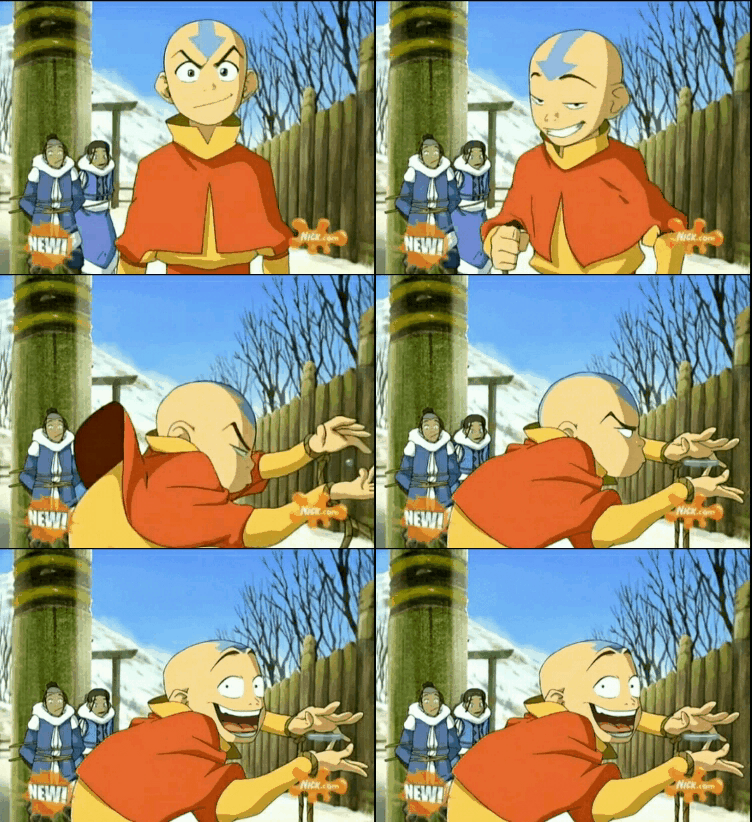
The air nomads brought fun to the world. They brought a very literal sense of lightheartedness.
Sozin saw this as a weakness. I think a lot of the world did, in ATLA. Why do the Air Nomads bother, right? They’re just up there in their temples, playing games, baking pies in order to throw them as a gag. As Iroh said above, they had pretty great senses of humour, and they didn’t take themselves too seriously.
But that’s a huge part of having a world of balance and peace.
It’s not just about power, or might, or the ability to adapt. You can have all of those, but you also need fun. You need the ability to be vulnerable, to have no ambitions beyond just having a good day. You need to be able to embrace silliness, to nurture play, to have that space where a very specific kind of emotional growth can occur. Fun makes a hard life a little easier. Fun makes your own mortality a little less frightening to grasp. Fun is the spaces in between, that can’t be measured by money or military might. Fun is what nurtures imagination, allows you to see a situation in a whole new light, to find new solutions to problems previously considered impossible.
Fun is what makes a stranger into a friend, rather than an enemy.
he’s mirroring! cats do that to be social that’s also why they will lie on laptops or books. they want to do what their humans are doing because they enjoy being in the same room and socializing that way. getting him his own prayer mat was a really good idea bc now he gets to mirror without being in the way!
The other thing is that cats have a very good sense of time and tend to like regular schedules. If OP’s family members pray every day at the same times, in the same place, the cat knows the drill and probably considers this an official Household Activity which requires Feline Supervision.
So last week an email got sent round my college asking if
anyone wanted to read some poetry to primary school kids and I was the only one
who responded and I asked if I could do some Shakespeare, since I have quite a
lot of experience with it, and the teacher said that would be fine.
So I was discussing with friends what I should do and they
said ‘er yeah, don’t do Shakespeare.’ And I was like ‘what why’ and they went ’well,
maybe if they’re over 10 but otherwise you’ll just get blank looks’ and I went ‘well
I don’t want to insult their intelligence’ and then another friend was like ‘hey
you should do that kid’s song ‘When I Was One’, they’ll like that!!’ (it’s a really
babyish song for toddlers with silly actions) and I thought about it and was ‘like
nah actually, I’ll do the ‘Once more unto the breach’ speech’
So I learned that over the week, and I was walking up to the
school, and the whole way I was thinking ‘Oh god this was a terrible idea they’re
going to hate it, they’re going to look at me blankly like those kids in The
Polar Express, my friends were right it’s going to be a disaster’, and I was
there early, so I sat in the classroom for the first half an hour, got given a
cupcake by some kids from a different class, said hello to some of the kids in
my class, they got a look at me.
At half 2 the teacher mentioned I would be reading some
poetry, and I asked if we could go outside, which she was more than happy to
allow, and the kids were all so confused (‘where are we going? Isn’t it only
poetry?’) and we got onto the field, the teacher got them all to stand an arm’s
length apart from each other, so I could walk around them, and I did a brief
overview of where the scene came in the play, how the king is on the
battlefield, talking to his soldiers (“Could all you be the soldiers?” “Yes!!”)
and they’re attacking the French, who are all in a castle (forgot it’s really a
castle town), and they’re attacking them through a gap in the wall, the breach.
Me and the teacher emphasised that if there was anything they didn’t
understand, that was completely fine and they could ask me at the end. I asked
the kids to watch for when I held my fist in the air, which is when they had to
cheer loudly, we had a practise at that, and then I did the speech.
Everything I had been scared about evaporated. All the kids
were totally engaged, they were all watching me, they all listened right the
way through, I saw lots of excited faces, and they all cheered really well at
the end.
Afterwards, there was a lot of chatter, several of them
asked me questions (”how do you remember all those words?”, “what did you mean when you talked about nostrils?”), one boy asked me to do it again, they were all really
lovely and had genuinely enjoyed it. It was so much fun, and they especially
loved it when I told them how my big college friends had told me not to do
Shakespeare because they wouldn’t like it. Those kids 100% proved them wrong
“After learning my flight was detained 4 hours,
I heard the announcement:
If anyone in the vicinity of gate 4-A understands any Arabic,
Please come to the gate immediately. Well—one pauses these days. Gate 4-A was my own gate. I went there.
An older woman in full traditional Palestinian dress,
Just like my grandma wore, was crumpled to the floor, wailing loudly.
Help, said the flight service person. Talk to her. What is her
Problem? we told her the flight was going to be four hours late and she
Did this. I put my arm around her and spoke to her haltingly.
Shu dow-a, shu- biduck habibti, stani stani schway, min fadlick,
Sho bit se-wee? The minute she heard any words she knew—however poorly used—
She stopped crying. She thought our flight had been canceled entirely.
She needed to be in El Paso for some major medical treatment the
Following day. I said no, no, we’re fine, you’ll get there, just late, Who is picking you up? Let’s call him and tell him.
We called her son and I spoke with him in English.
I told him I would stay with his mother till we got on the plane and
Would ride next to her—Southwest. She talked to him. Then we called her other sons just for the fun of it. Then we called my dad and he and she spoke for a while in Arabic and
Found out of course they had ten shared friends. Then I thought just for the heck of it why not call some Palestinian
Poets I know and let them chat with her. This all took up about 2 hours. She was laughing a lot by then. Telling about her life. Answering
Questions. She had pulled a sack of homemade mamool cookies—little powdered
Sugar crumbly mounds stuffed with dates and nuts—out of her bag—
And was offering them to all the women at the gate. To my amazement, not a single woman declined one. It was like a
Sacrament. The traveler from Argentina, the traveler from California,
The lovely woman from Laredo—we were all covered with the same
Powdered sugar. And smiling. There are no better cookies. And then the airline broke out the free beverages from huge coolers—
Non-alcoholic—and the two little girls for our flight, one African
American, one Mexican American—ran around serving us all apple juice
And lemonade and they were covered with powdered sugar too. And I noticed my new best friend—by now we were holding hands—
Had a potted plant poking out of her bag, some medicinal thing, With green furry leaves. Such an old country traveling tradition. Always
Carry a plant. Always stay rooted to somewhere. And I looked around that gate of late and weary ones and thought,
This is the world I want to live in. The shared world. Not a single person in this gate—once the crying of confusion stopped
—has seemed apprehensive about any other person. They took the cookies. I wanted to hug all those other women too.
This can still happen anywhere. Not everything is lost.”
—
Naomi Shihab Nye (b. 1952), “Wandering Around an Albuquerque Airport Terminal.” I think this poem may be making the rounds, this week, but that’s as it should be. (via oliviacirce)
When I lose hope in the world, I remember this poem.
i just bawled my eyes out and it feels like i just got the biggest hug to my soul. thank you thank you thank you. it is sacred and it is SAFE the poster will not tell anyone even what state this is in, only thats this is in USA. even if you are not indigenous i hope this lifts your spirits and comforts you.
“Goethe’s final words: “More light.” Ever since we crawled out of that primordial slime, that’s been our unifying cry: “More light.” Sunlight. Torchlight. Candlight. Neon. Incandescent. Lights that banish the darkness from our caves, to illuminate our roads, the insides of our refrigerators. Big floods for the night games at Soldier’s field. Little tiny flashlight for those books we read under the covers when we’re supposed to be asleep. Light is more than watts and footcandles. Light is metaphor. Thy word is a lamp unto my feet. Rage, rage against the dying of the light. Lead, Kindly Light, amid the encircling gloom – Lead Thou me on! The night is dark, and I am far from home – Lead Thou me on! Arise, shine, for thy light has come. Light is knowledge. Light is life. Light is light.”


 love galore